
Patios & Pool Decks
The back yard stops being a view and starts being a room.
Paver and travertine floors, laid level, edged so they stay that way.
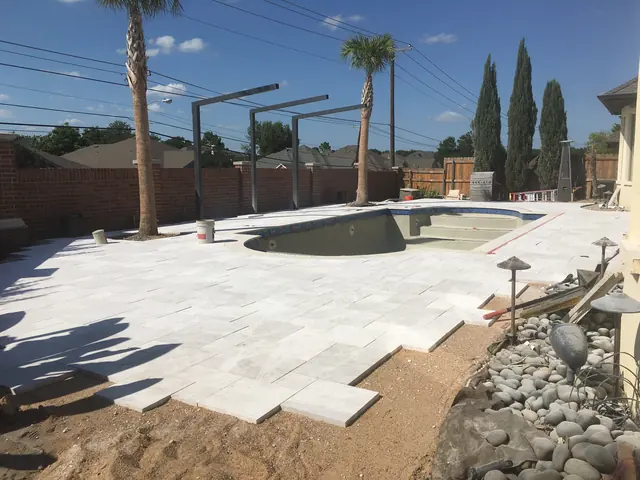
What goes into a deck
- Excavation to a depth set by the ground, not by habit
- Base compacted in layers, with falls set away from the house
- Edge restraint in before the field is laid, never after
- Cuts made at the coping, the steps and the house wall
- Joints filled and the whole field compacted in
How the field gets laid
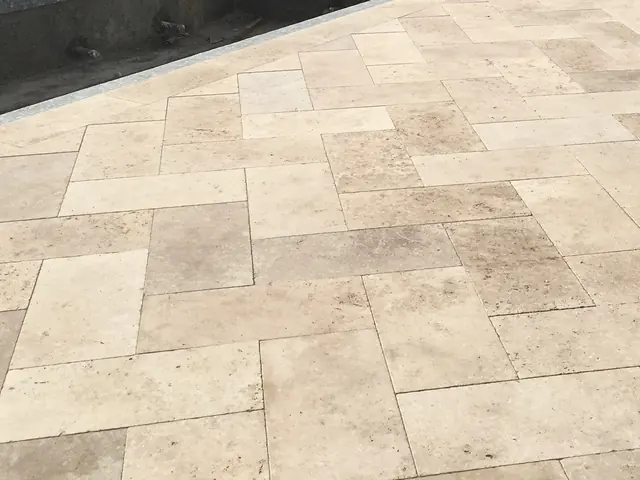
All four are in our own photographs. The choice changes the look, the waste and how much cutting there is at the edges.
Four tile sizes repeating in a block. It is the pattern on the travertine pool deck in our gallery: it breaks up a large area so it does not read as a grid, and it hides the small variations you get in natural stone.
Driveways & Walkways
A driveway is a structure, not a surface.
Large-format slabs, pavers and set stepping runs, built off the base up.
What goes into it
- Depth set by what the ground is, not by a standard build-up
- Sub-base compacted in layers rather than in one pass
- Edge restraint down both sides before the field goes in
- Falls run to where water can actually leave the property
- Cut-in bands, borders or gravel joints where the design calls for it
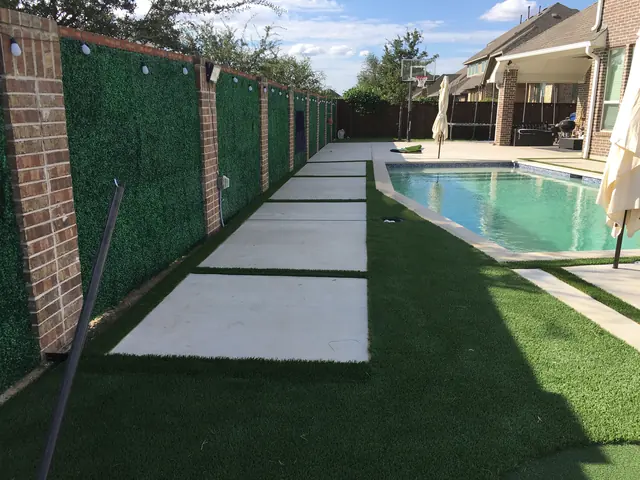
Three ways to surface the front
We do all three, and all three are in our photographs. The right one depends on the ground more than on the budget.
Poured concrete
- One continuous surface, nothing to shift
- Takes a finish: broom, exposed aggregate, stain
- Fewest joints to maintain
- On clay it cracks where the ground moves, and a crack is permanent
- A repair is always visible
- Has to cure before anyone drives on it
Pavers
- Individual units move with the ground instead of cracking
- A damaged area can be lifted and relaid
- Drivable as soon as it is compacted in
- More edge cutting, so more labor
- Wants edge restraint or the field creeps
- Joints need topping up over the years
Large slabs, open joints
- Modern look, very few visible lines
- Water drains through the joints rather than to one edge
- Gravel or grass joints soften a big area
- Each slab is heavy and has to be set exactly
- Joints need keeping clear of weeds
- Not every slab is rated to take a vehicle, so the spec matters
Solid marks are the case for it, gray marks the cost of it. Both are real; which one wins depends on the property.
Paver Repair & Releveling
Most paving does not fail. Its base does.
Lifting, regrading and relaying the sunk area instead of replacing the lot.
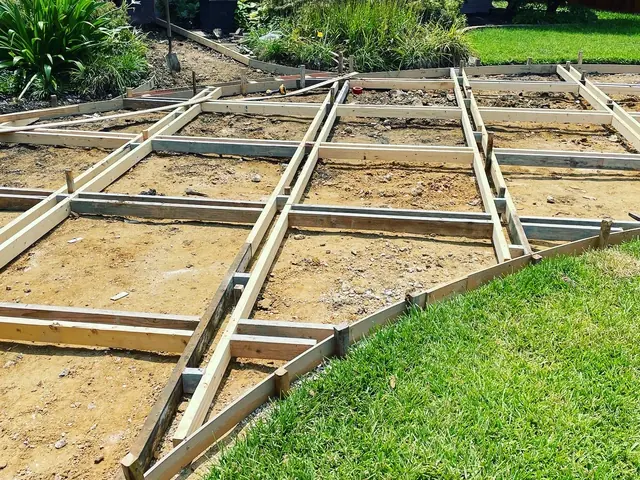
What a repair involves
- Lifting the affected area and stacking the units to go back
- Finding where the water is getting in, before anything is relaid
- Regrading and recompacting the base under the failed section
- Relaying to the level of the paving around it, not to its own level
- Rejointing and compacting the field in
What is yours doing?
Tick what you can see. This counts what you ticked; it does not diagnose anything. It exists so the two of you are looking at the same list on the phone.
Questions
Questions people actually ask.
Patios & Pool Decks
Can you lay over the concrete that is already there?
Sometimes, and it is worth asking about before you pay to break one out. It depends on whether the slab is sound, what it does to the height at your door, and whether water can still get away. If the slab is already moving, laying over it just moves the problem up.
What is the gap between the units for?
On an open-joint deck it is drainage and movement. Water goes down through the joint instead of running to one edge, and each unit can settle a little without cracking its neighbor. On a tight-jointed deck it is the opposite: the joint sand locks the field together.
How close to the pool can you work?
Right up to the coping. That is where the cuts are and where the detail shows, so it is worth walking that line with us before anything is ordered.
Driveways & Walkways
Will it take a truck?
That is a question about the build-up, not the surface. Depth, compaction and edge restraint are what carry a load, and they change with what is under the site. Say what you park on it before anything is quoted.
Can the drive be done in one weekend?
No honest answer here fits every job. Excavation depends on what comes out, and poured concrete has to cure whatever the schedule says. He can tell you what your access allows once he has seen it.
Do you match the existing concrete apron?
You cannot color match old concrete, and anyone who says otherwise is guessing. What can be done is to make the join deliberate: a band, a change of material, or a cut line that reads as a decision instead of a repair.
Paver Repair & Releveling
Do the old units go back down?
Usually, yes. Pavers and slabs are rarely what failed, and reusing them is both cheaper and a better match than anything bought new. Broken ones get swapped, which is why keeping a few spares from the original job is worth doing.
Why did it sink in one spot and nowhere else?
Because something concentrated water there: a downspout, a broken irrigation line, a trench that was backfilled loose, or a low point in the grade. The area that sank is the symptom. Finding what fed it is the repair.
Can you fix a section, or does the whole patio have to come up?
A section, in most cases. The repair has to be relaid to the level of the paving around it rather than to its own, or you trade one sunk patch for two visible joins.
Paving & Stone
What you drive on, walk on and put the furniture on. Send photos of the space and someone will come and look at it.